
Can a Worn JH70 Motorcycle Rear Fork Bracket Cause Dangerous Rear Wheel Misalignment
2026-07-01
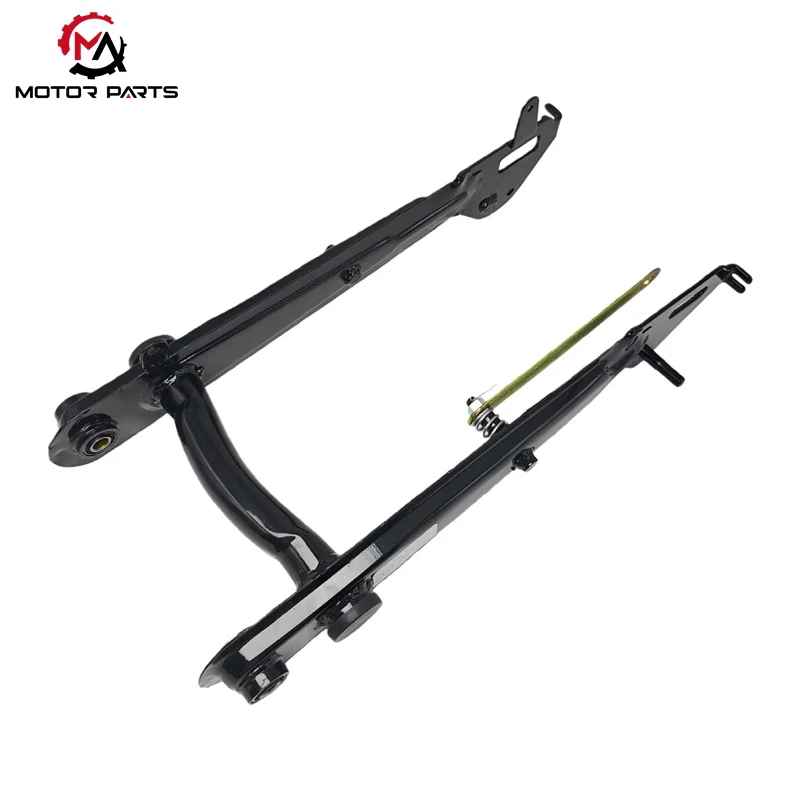
If you ride a Honda JH70 or any clone variant, the JH70 Motorcycle Rear Fork Bracket is one component you cannot afford to ignore. This cast or steel pivot assembly connects your swingarm to the frame, and when it wears out, the rear wheel no longer tracks straight behind the front. At Max Trading, we have inspected hundreds of these brackets across workshop floors, and the short answer is yes—a worn JH70 Motorcycle Rear Fork Bracket can absolutely create hazardous misalignment that compromises braking, cornering, and chain stability.
How the Bracket Controls Rear Wheel Geometry
The JH70 Motorcycle Rear Fork Bracket houses the pivot shaft and needle bearings that allow vertical swingarm movement. When the bracket’s inner bore ovalises, or when the pivot bolt hole enlarges from metal fatigue, the swingarm shifts laterally. This changes the rear wheel’s thrust angle relative to the front tyre. Even a 2–3 mm offset translates into a noticeable crab-walk effect at speeds above 40 km/h.
Signs of Misalignment from a Worn Bracket
| Symptom | What It Feels Like | Risk Level |
|---|---|---|
| Uneven tyre wear (one side bald) | Bike pulls to one side under acceleration | Moderate |
| Chain skipping or jumping off sprocket | Jerky power delivery, clattering noise | High |
| Handlebar wobble at 50–60 km/h | Front end shakes even on flat roads | Critical |
| Rear brake drags inconsistently | Pedal feels spongy, braking distance increases | High |
| Visible gap between swingarm and frame | Measurable with a feeler gauge >1.5 mm | Severe |
Why This Becomes Dangerous
A misaligned rear wheel does more than ruin your tyres. It changes the effective wheelbase on one side, causing the bike to steer differently in left vs right turns. More critically, the chain line shifts, placing extreme side-load on the output shaft bearing inside the gearbox. We have seen snapped chains, cracked engine casings, and even frame fractures trace back to a neglected JH70 Motorcycle Rear Fork Bracket. At Max Trading, we categorise this as a red-flag repair item during any pre-ride safety inspection.
Professional Inspection Checklist (Do This Every 3,000 km)
-
Visual check: Look for rust bleeding around the pivot bolt—this indicates internal bearing collapse.
-
Play test: With the bike on a centre stand, grab the rear wheel at 3 and 9 o’clock and push/pull. Any lateral movement over 1.0 mm means the bracket or bearings are worn.
-
Torque verification: The pivot bolt must be tightened to 45–50 Nm. Loose bolts accelerate bracket bore wear.
-
Bearing condition: Remove the pivot shaft and inspect the needle rollers. If any rollers are missing or flattened, replace the bracket assembly—not just the bearings.
Replacement vs. Repair – What Max Trading Recommends
| Option | Cost | Durability | Safety | Best For |
|---|---|---|---|---|
| Weld and re-bore the old bracket | Low | Short-term (6–12 months) | Risky – heat weakens cast metal | Temporary trail fix only |
| Install aftermarket steel bracket | Medium | 3–5 years | Good – but check fitment | Budget-conscious owners |
| OEM-spec reinforced bracket from Max Trading | Moderate | 5–8 years | Excellent – precision machined | Daily riders and restorers |
Our experience shows that welding a cracked JH70 Motorcycle Rear Fork Bracket often fails within weeks because the cast alloy becomes brittle around the heat-affected zone. We consistently advise full replacement using a bracket that features an oversized pivot bore with replaceable bronze bushings—exactly the type Max Trading supplies for JH70 enthusiasts worldwide.
JH70 Motorcycle Rear Fork Bracket FAQ – Common Questions
Q: How many kilometres can I expect from a stock JH70 Motorcycle Rear Fork Bracket before it wears out?
A: Under normal street use with regular greasing every 2,000 km, the stock cast bracket typically lasts 25,000–30,000 km. However, off-road riding, heavy loads, or loose pivot bolts can reduce that to 10,000–12,000 km. The bore ovalisation is the primary failure mode. Once you measure more than 0.5 mm of out-of-roundness with a dial gauge, replacement is due. Max Trading recommends proactive replacement at 20,000 km if you frequently ride on rough terrain.
Q: Can I just replace the needle bearings and keep the old JH70 Motorcycle Rear Fork Bracket to save money?
A: You can, but it is rarely effective. The bearings are only half of the equation—the bracket’s internal bore wears faster than the bearing outer race. Installing new bearings into an ovalised bore leaves them unsupported, and they will fail within 3,000–5,000 km. Moreover, the new bearings will not correct lateral play caused by a stretched pivot bolt hole. The cost-effective and safe approach is to purchase a complete bracket-and-bearing kit from Max Trading, which guarantees matched tolerances and eliminates guesswork.
Q: How do I accurately measure misalignment caused by a bad JH70 Motorcycle Rear Fork Bracket without expensive laser tools?
A: Use the string method. Tie a long piece of string around the rear tyre’s centre tread, run it forward past the front tyre, and align it so it just touches the front tyre’s sidewall on both sides. Measure the distance from the string to the swingarm pivot area on each side. A difference greater than 2.0 mm between left and right indicates the JH70 Motorcycle Rear Fork Bracket is pushing the swingarm off-centre. For final confirmation, place a straightedge across the rear sprocket face and check if it points directly at the front sprocket—any angular deviation confirms bracket wear.
Final Verdict
A worn JH70 Motorcycle Rear Fork Bracket is not a gradual nuisance—it is a progressive safety hazard. Left unchecked, it degrades chain life, overheats rear bearings, and dramatically increases stopping distances because the rear tyre no longer brakes in a straight line. Every professional mechanic we work with at Max Trading places this bracket on the same priority level as brake pads and tyres.
Contact Us Today
Do not guess about your rear-end geometry. Max Trading stocks precision-engineered JH70 Motorcycle Rear Fork Bracket assemblies with upgraded lubrication channels and hardened pivot pins. We ship worldwide with fitment guides and torque charts. Contact our technical team now for a free compatibility check—send your bike’s VIN or frame number, and we will respond within 4 business hours. Your safety rides on that bracket. Let us help you keep it straight.